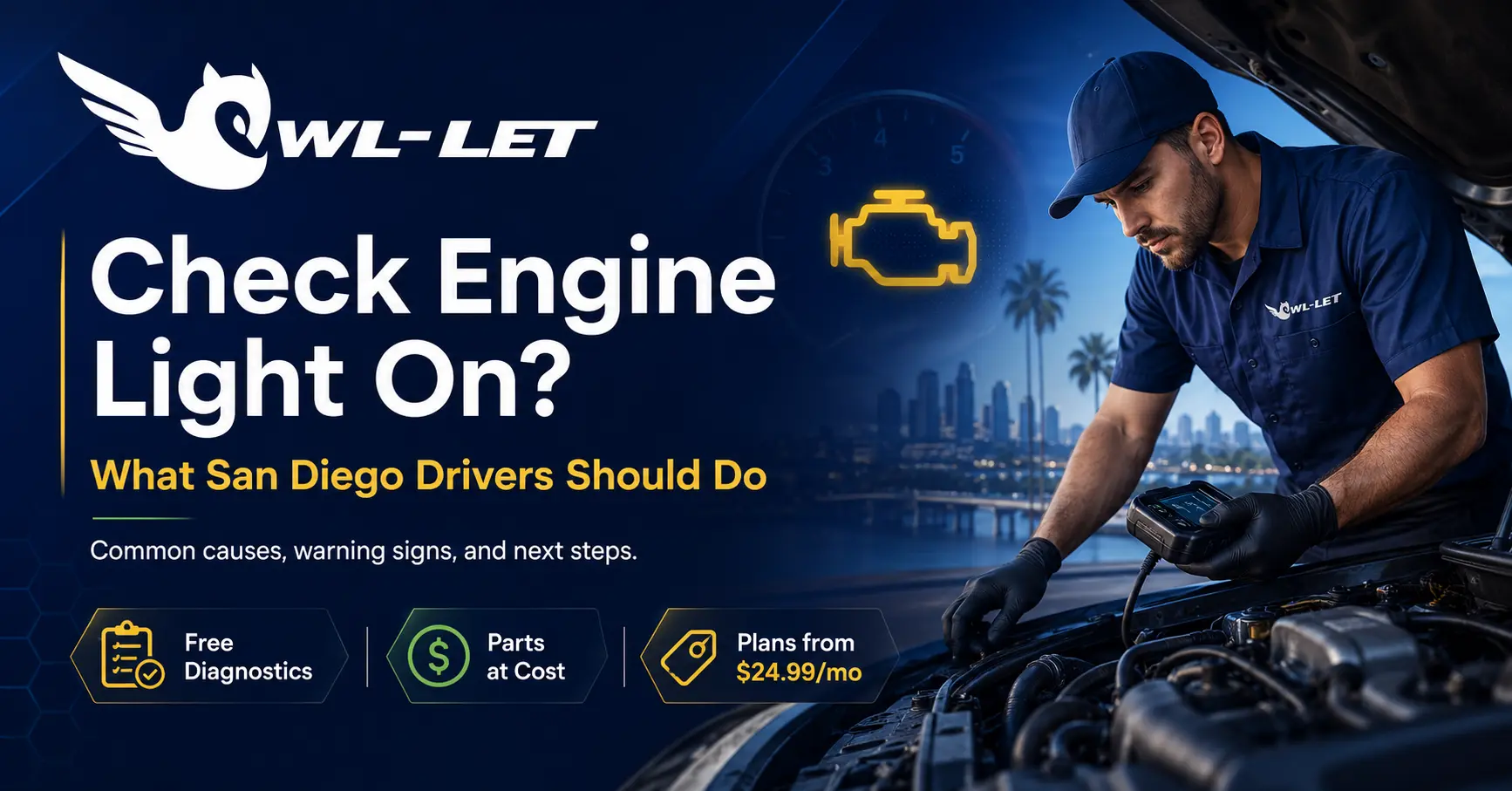
Check Engine Light On? What San Diego Drivers Should Do
Few dashboard warnings create as much uncertainty as the check engine light.
It may appear while the vehicle seems to drive normally, or it may turn on along with shaking, poor acceleration, unusual sounds, or reduced fuel economy. Some drivers immediately assume the engine is failing. Others ignore the warning because the car still moves.
Neither reaction is ideal.
A check engine light can be triggered by something relatively simple, such as a loose fuel cap, or by a more serious problem involving the ignition, emissions, fuel, electrical, or engine-management system.
The correct next step is to determine whether the light is steady or flashing, pay attention to how the vehicle is behaving, and arrange a proper diagnostic inspection.
What Does the Check Engine Light Mean?
The check engine light is part of the vehicle’s onboard diagnostic system.
Modern vehicles use computers and sensors to monitor engine performance, emissions, fuel delivery, ignition, transmission operation, and other systems. When the computer detects a problem outside its expected operating range, it may store a diagnostic trouble code and illuminate the check engine light.
The warning light does not identify the failed part by itself.
It only tells you that the vehicle has detected a condition requiring further investigation.
A technician may need to:
-
Scan the vehicle for stored trouble codes
-
Review live sensor data
-
Inspect wiring and connectors
-
Test ignition components
-
Check fuel and air delivery
-
Inspect the emissions system
-
Look for vacuum or fluid leaks
-
Perform electrical or mechanical testing
A diagnostic code is the beginning of the investigation, not always the final answer.
Steady vs. Flashing Check Engine Light
The way the light appears can help indicate the urgency of the problem.
Steady Check Engine Light
A steady check engine light generally means the vehicle computer detected a problem that should be diagnosed soon.
The vehicle may continue driving normally, but the issue should not be ignored. Continuing to drive for a long period may worsen the problem, reduce fuel efficiency, increase emissions, or lead to additional repairs.
If the vehicle is running normally and no other serious warning lights are present, schedule a diagnostic appointment as soon as practical.
Flashing Check Engine Light
A flashing check engine light is more urgent.
It may indicate an active engine misfire or another condition capable of damaging the catalytic converter or engine components.
When the light is flashing:
-
Reduce speed.
-
Avoid hard acceleration.
-
Turn off unnecessary electrical loads.
-
Move to a safe location.
-
Stop driving if the vehicle is shaking, overheating, losing power, or making unusual noises.
-
Arrange professional inspection or towing.
Do not continue driving normally while a check engine light is flashing.
Common Causes of a Check Engine Light
There are many possible causes, and the correct diagnosis depends on the vehicle and stored codes.
Loose or Damaged Fuel Cap
A loose, missing, or damaged fuel cap can allow fuel vapors to escape and trigger an emissions-system code.
After refueling, check whether the cap is properly tightened. Some vehicles require several driving cycles before the warning turns off after the issue is corrected.
A fuel-cap check is useful, but it should not replace professional diagnosis when the light remains on.
Faulty Oxygen Sensor
Oxygen sensors monitor the exhaust and help the engine computer adjust the fuel mixture.
A failing sensor may cause:
-
Poor fuel economy
-
Rough running
-
Increased emissions
-
Reduced performance
-
Catalytic-converter damage over time
The trouble code may identify the sensor circuit, but additional testing may be necessary before replacing a part.
Ignition Misfire
A misfire occurs when one or more cylinders fail to burn the air-fuel mixture correctly.
Possible causes include:
-
Worn spark plugs
-
Failing ignition coils
-
Fuel-injector problems
-
Vacuum leaks
-
Low compression
-
Wiring faults
-
Fuel-delivery problems
A serious misfire may cause the check engine light to flash.
Catalytic Converter Problems
The catalytic converter helps reduce harmful exhaust emissions.
Converter-related codes may result from:
-
Internal converter failure
-
Long-term engine misfires
-
Oil or coolant entering the exhaust
-
Incorrect fuel mixture
-
Faulty oxygen sensors
-
Exhaust leaks
Replacing the converter without correcting the original cause may result in another failure.
Mass Airflow Sensor Problems
The mass airflow sensor measures the air entering the engine.
A dirty or failing sensor can contribute to:
-
Hard starting
-
Poor acceleration
-
Engine hesitation
-
Rough idle
-
Reduced fuel economy
-
Incorrect fuel mixture
The intake system and wiring should be inspected before assuming the sensor needs replacement.
Vacuum or Intake Leak
Cracked hoses, loose intake connections, damaged gaskets, or other air leaks can cause the engine to receive unmeasured air.
Possible symptoms include:
-
Rough idle
-
High idle
-
Hesitation
-
Lean fuel-mixture codes
-
Reduced performance
-
Whistling sounds
Battery or Charging-System Problems
Low voltage can sometimes create communication or sensor-related faults.
A weak battery, failing alternator, poor electrical connection, or damaged ground may cause warning lights and unusual vehicle behavior.
Emissions-System Leak
The evaporative emissions system captures fuel vapors instead of allowing them to escape.
A small leak may come from:
-
A damaged fuel cap
-
Cracked vapor hoses
-
Faulty valves
-
A leaking charcoal canister
-
Electrical problems
Specialized smoke testing may be required to locate a small leak.
Can You Keep Driving With the Check Engine Light On?
It depends on the warning and vehicle symptoms.
You may be able to drive a short distance for inspection when:
-
The light is steady
-
The engine sounds normal
-
The vehicle is not shaking
-
There is no major power loss
-
The temperature gauge is normal
-
No oil-pressure warning is present
-
No strong fuel or burning smell is present
Stop driving and seek assistance when:
-
The check engine light is flashing
-
The engine is shaking badly
-
The vehicle is overheating
-
The oil-pressure light is on
-
The car is losing power
-
You smell fuel
-
You see smoke
-
The engine makes knocking or grinding sounds
-
Multiple serious warning lights appear
When safety is uncertain, towing is usually less expensive than risking engine, transmission, or catalytic-converter damage.
What Is a Diagnostic Trouble Code?
When the vehicle detects a fault, it may store a diagnostic trouble code, often called a DTC.
Examples include codes beginning with:
-
P for powertrain
-
B for body
-
C for chassis
-
U for network or communication
A basic code reader can display the stored code, but the code does not always identify the exact failed part.
For example, an oxygen-sensor code might be caused by:
-
A failed sensor
-
Damaged wiring
-
An exhaust leak
-
An incorrect fuel mixture
-
An engine misfire
-
A vacuum leak
Replacing the component named in a code description without testing can waste money and leave the real problem unresolved.
Code Scan vs. Complete Vehicle Diagnosis
A code scan and a diagnosis are not the same service.
Code Scan
A basic scan may:
-
Retrieve stored codes
-
Clear warning lights
-
Show limited vehicle information
Professional Diagnosis
A complete diagnosis may include:
-
Reviewing all vehicle modules
-
Checking current and historical codes
-
Examining freeze-frame data
-
Reading live sensor information
-
Testing electrical circuits
-
Inspecting parts and wiring
-
Reproducing the symptoms
-
Comparing values with specifications
-
Confirming the cause before recommending repairs
Clearing the warning light without correcting the problem may only make it disappear temporarily.
How Much Does Check Engine Light Diagnosis Cost?
Diagnostic charges vary based on the vehicle, problem, testing time, equipment, and repair provider.
Some problems are identified quickly. Others involve intermittent electrical faults, leaks, communication problems, or several systems that require more testing.
Ask the repair provider:
-
What is included in the diagnostic charge?
-
Is the fee for scanning or complete testing?
-
Will the technician confirm the failed component?
-
Will I receive a written repair estimate?
-
Is diagnostic time applied toward the repair?
-
Are additional testing charges possible?
The cheapest scan is not always the least expensive solution. An incorrect diagnosis can result in unnecessary parts and repeated repairs.
Free Car Diagnostics With OWL-LET
OWL-LET membership plans include free diagnostics for members.
That can help San Diego drivers understand why a warning light is on before approving a repair.
Depending on the problem, additional procedures, specialized testing, repair labor, or replacement parts may still be required. Membership terms and service limitations apply.
OWL-LET also provides access to:
-
Parts-at-cost pricing
-
Member labor rates
-
Maintenance services
-
Oil-change benefits on qualifying plans
-
Roadside benefits depending on the plan
-
Local auto repair service
Membership plans start at $24.99 per month.
Not every membership includes the same oil-change, towing, or roadside benefits, so review the current plan comparison before enrolling.
Why Parts-at-Cost Pricing Matters
A check engine light repair may require a sensor, ignition coil, fuel-system component, emissions part, electrical component, or other replacement part.
Traditional repair invoices often include a retail markup on parts.
OWL-LET members may receive qualifying parts at cost rather than paying a traditional retail markup. Labor, taxes, supplies, and other applicable charges may still apply.
Actual savings depend on:
-
The vehicle
-
The failed component
-
Part availability
-
The repair required
-
Membership terms
Parts-at-cost pricing can be especially valuable when a diagnosis identifies several failed or worn components.
Should You Clear the Check Engine Light Yourself?
Clearing a code does not repair the problem.
It may also erase useful diagnostic information, including freeze-frame data showing what the vehicle was doing when the fault occurred.
Removing the battery cable or using a scanner to clear the light may:
-
Temporarily hide the warning
-
Reset vehicle monitors
-
Make emissions testing more difficult
-
Erase information useful to the technician
-
Delay the proper repair
It is usually better to have the codes inspected before clearing them.
How to Prevent Future Check Engine Lights
Not every warning can be prevented, but routine maintenance may reduce avoidable problems.
Helpful steps include:
-
Follow the recommended oil-change schedule
-
Replace spark plugs when required
-
Inspect belts and hoses
-
Maintain the battery and charging system
-
Use the correct fuel
-
Tighten the fuel cap after refueling
-
Replace dirty air filters
-
Address fluid leaks
-
Do not ignore rough running
-
Repair small problems before they affect other systems
A vehicle maintenance plan can make it easier to stay consistent with routine inspections and service.
Choosing a Mechanic for Check Engine Light Diagnosis
When searching for a mechanic or car diagnostics near you, look for more than a low advertised price.
Choose a provider that:
-
Explains the diagnostic process
-
Tests before replacing parts
-
Provides a written estimate
-
Separates parts and labor
-
Answers questions clearly
-
Does not pressure you into immediate repairs
-
Documents codes and test results
-
Can handle the final repair if needed
A trustworthy diagnosis should explain what failed, how it was tested, what repair is recommended, and what may happen if the repair is delayed.
Check Engine Light Service in San Diego
OWL-LET serves San Diego drivers with vehicle diagnostics, maintenance, oil changes, and auto repair services.
Service Center:
1739 Palm Ave, San Diego, CA 92154
Phone:
+1 (619) 777-0031
Drivers can schedule a diagnostic inspection, compare membership plans, or ask about available service options.
Final Thoughts
A check engine light should not be ignored, but it also does not automatically mean the engine has failed.
The cause may be a loose fuel cap, sensor problem, misfire, emissions leak, electrical fault, or another condition requiring professional testing.
A steady light should be diagnosed soon. A flashing check engine light requires immediate caution and may mean the vehicle should not continue driving.
OWL-LET helps San Diego drivers access free diagnostics through qualifying memberships, along with parts-at-cost pricing and other plan-based benefits.
Membership plans start at $24.99 per month.
Call OWL-LET: +1 (619) 777-0031
Service Center: 1739 Palm Ave, San Diego, CA 92154
Website: www.owl-let.com
Diagnostic services, roadside benefits, oil changes, towing, limits, eligibility, pricing, and availability vary by plan. Review current membership terms before enrolling.
Comments 0
No comments yet
Be the first!