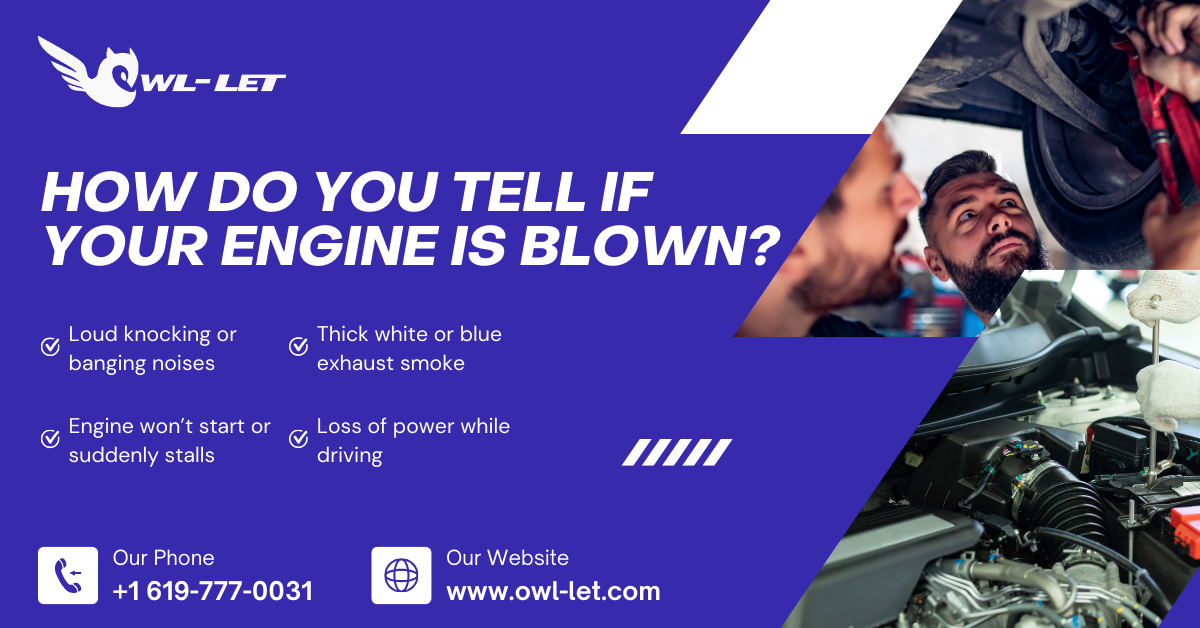
To tell if your engine is blown, look for a total loss of power accompanied by a loud knocking or metallic clanging sound. Other definitive signs include thick white or blue smoke from the exhaust, "milky" oil on the dipstick (coolant contamination), or a seized engine that refuses to crank.
Key Takeaways: Identifying a Catastrophic Engine Failure
|
Symptom |
Description |
Severity Level |
|
Knocking Sound |
Heavy metallic rhythmic thudding (Rod Knock). |
Terminal |
|
Exhaust Smoke |
Thick Blue (Oil burning) or White (Coolant/Head Gasket). |
Critical |
|
Metal Shavings |
Shiny flakes found in the oil pan or on the dipstick. |
Terminal |
|
Seized Crank |
Engine won't turn over even with a fresh battery. |
Total Failure |
|
The "Milkshake" |
Oil and coolant mixing into a frothy brown sludge. |
Major Repair |
How do you tell if your engine is blown?
As a Senior Automotive Consultant with years of experience diagnosing "dead" vehicles at Owl-Let, I’ve seen the look of dread when a driver asks, how do you tell if your engine is blown? A "blown" engine isn't a single specific part breaking; it’s a generic term used when internal components suffer damage so severe that the engine can no longer function without a complete rebuild or replacement.
In 2026, modern engines are built with tighter tolerances than ever. While this makes them efficient, it also means that when things go wrong—due to overheating, oil starvation, or timing belt failure—they go wrong spectacularly. Understanding the thermodynamic limits and structural integrity of your block is the first step in knowing if your car is a candidate for a repair or the scrap yard.
[Image showing an engine with a hole in the side of the block or a severely damaged piston]
What are the most common sounds of a blown engine?
One of the most immediate ways to answer how do you tell if your engine is blown? is by using your ears. A healthy engine hums; a dying engine screams for help.
1. The Dreaded "Rod Knock"
If you hear a deep, rhythmic metallic hammering that gets faster as you accelerate, your connecting rod bearings have likely failed. This creates "play" between the rod and the crankshaft. Eventually, the rod can snap and punch a hole through the engine block—an event we call "throwing a rod."
2. Top-End Tapping or Valvetrain Noise
Rapid ticking often indicates a lack of oil pressure reaching the lifters or camshafts. While sometimes fixable, if left ignored, it leads to a seized top-end, effectively blowing the engine.
What color smoke indicates a blown engine?
The exhaust is the window into your engine's internal health. If you see smoke lingering behind you, the color tells the story:
-
Thick White Smoke: This usually indicates a blown head gasket. Coolant is leaking into the combustion chamber and being vaporized. It often smells sweet (like maple syrup).
-
Blue/Grey Smoke: This means your engine is "eating" its own oil. This is caused by failed piston rings or valve seals. If the smoke is constant and heavy, your engine’s internal seals have reached terminal wear.
-
Black Smoke: This is typically a fuel-to-air ratio issue (running "rich"). While not always a sign of a blown engine, prolonged black smoke can "wash" the cylinder walls of oil, leading to a seizure.
Why does the 'Milkshake' oil mean your engine is done?
When you check your oil level—which is the proper way to check the oil level in your car to prevent these issues—you might find a substance that looks like a chocolate milkshake.
This occurs when the internal seals fail, allowing engine coolant to mix with the lubricating oil.
-
The Result: The mixture loses its viscosity and cannot lubricate the bearings.
-
The Outcome: Total friction-based meltdown. At Owl-Let, we consider the "milkshake" a 90% indicator that the engine requires a full teardown.
Can a car still start with a blown engine?
Sometimes, yes—but not for long.
-
An engine with a blown head gasket may start but will overheat within minutes and misfire constantly.
-
An engine with a thrown rod might technically fire up, but the mechanical clanging will be deafening, and it will eventually seize.
-
However, a seized engine (where metal has welded to metal due to heat) will not turn over at all. You’ll hear a single "click" from the starter motor, but the crankshaft will remain frozen.
How do metal shavings in your oil signal a dead engine?
During your next oil change, look closely at the old oil. If you see glitter or silver flakes in the oil pan, your engine is literally grinding itself to pieces. These flakes are usually the remnants of your engine's main bearings. Once these bearings are gone, the friction becomes so high that the engine "blows" shortly after.
Expert Tip: Use a magnet on the oil. If the shavings are magnetic (steel/iron), it’s likely your camshaft or cylinders. If they aren't (aluminum/babibitt), it’s your bearings. Either way, the diagnosis is grim.
Is it worth fixing a blown engine in 2026?
This depends on the vehicle's value.
-
Engine Replacement: Costs typically range from $4,000 to $10,000 depending on if the engine is new, used, or remanufactured.
-
Vehicle Value: If you drive a 15-year-old sedan, the repair will cost more than the car is worth.
-
The Owl-Let Advantage: This is why we advocate for our Owl-Let Car Service Membership. For just $24.99 Monthly, we provide the preventative diagnostics that catch these failures before they become "blown" engines.
Expert Conclusion: Prevention is cheaper than a cure
Identifying how do you tell if your engine is blown? is a skill every driver should have, but it's a situation no driver wants to be in. Whether it’s the "milkshake" oil, the rod knock, or the clouds of white smoke, these signs are the final heartbeat of a neglected machine.
Don't let your car reach the point of no return. At Owl-Let, we specialize in keeping you on the road and out of the scrap yard. Our Owl-Let Car Service Membership starts at just $24.99 monthly, offering you a safety net of expert inspections and maintenance. Visit www.owl-let.com to secure your vehicle’s future today.
Comments 0
No comments yet
Be the first!