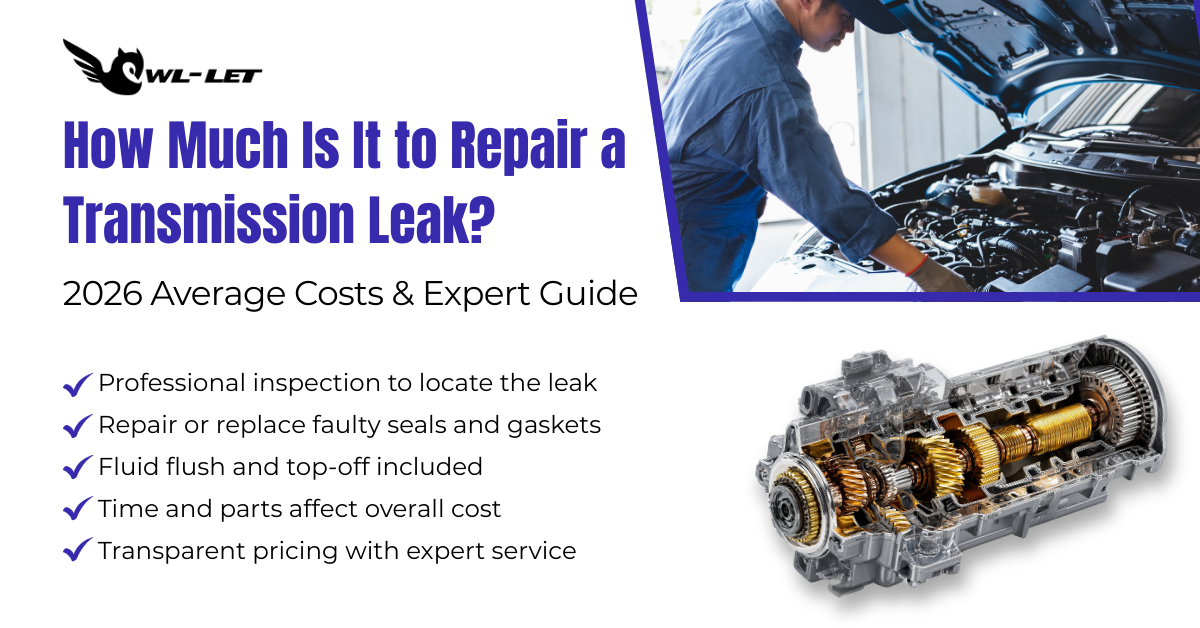
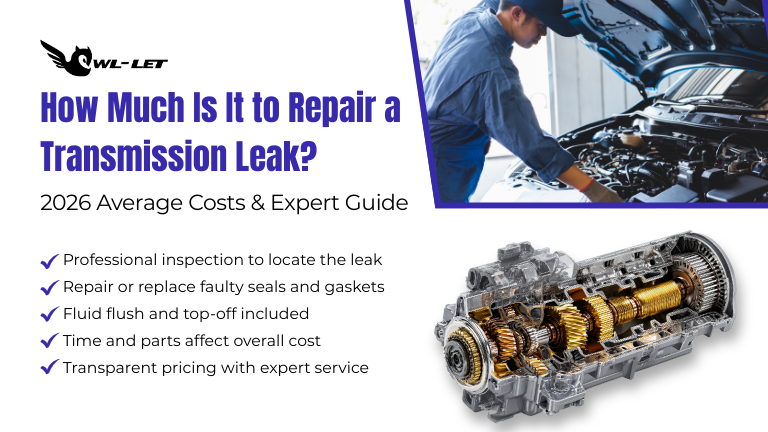
On average, a transmission leak repair costs between $150 and $400 for minor issues like a pan gasket or seal replacement. However, if the leak stems from a front seal or requires removing the transmission, costs can escalate to $800–$1,200. Extensive damage from running low on fluid may lead to a rebuild costing $3,000+.
Quick Cost Breakdown: Transmission Leak Repairs
|
Repair Type |
Estimated Cost (Parts & Labor) |
Complexity |
|
Pan Gasket Replacement |
$150 – $350 |
Low |
|
Transmission Cooler Line |
$200 – $450 |
Medium |
|
Drain & Fill Service |
$150 – $300 |
Low |
|
Front/Rear Output Seal |
$400 – $900 |
High |
|
Torque Converter Seal |
$600 – $1,200 |
Very High |
Why Is My Car Leaking Red Fluid?
Finding a puddle of reddish, oily liquid on your driveway is the primary indicator that you need to know how much is it to repair a transmission leak. Transmission fluid is specifically dyed red (though it turns dark brown as it ages) to distinguish it from motor oil or coolant.
At Owl-Let, we’ve seen that ignoring these "minor" spots is the most expensive mistake a driver can make. Transmission systems rely on hydraulic pressure to shift; when fluid levels drop, the internal friction increases exponentially, leading to catastrophic failure. Modern 2026 vehicles with 8-, 9-, or 10-speed transmissions are even more sensitive to fluid levels than older models.
What Factors Influence the Final Repair Bill?
When you ask a mechanic, "How much is it to repair a transmission leak?" the answer depends on three major variables.
1. The Location of the Leak
-
External Leaks: These are typically cheaper. Replacing a shifter linkage seal or a transmission pan gasket can often be done without removing the entire unit.
-
Internal/Main Seals: If the front pump seal or the torque converter seal is leaking, the entire transmission must be pulled from the vehicle. This adds $500–$800 in labor costs alone.
2. Vehicle Make and Model
Luxury imports and heavy-duty trucks often require specialized fluids and proprietary parts. For instance, a CVT (Continuously Variable Transmission) in a compact car may have different seal requirements than a dual-clutch system in a performance vehicle.
3. The Severity of the Damage
If you've been driving with a leak for weeks, the "repair" might transition from a simple seal swap to a full transmission overhaul.
Is a Transmission Leak Worth Fixing?
Absolutely. A transmission leak is one of the few automotive issues where the "fix" is significantly cheaper than the "consequence." Spending $200 today to replace a cracked fluid line prevents a $4,000 replacement tomorrow. At Owl-Let, we recommend a "Detect Early, Save Heavy" philosophy. If your transmission starts slipping or hesitating, the leak has likely already caused internal pressure loss.
How to Identify the Source of a Transmission Leak?
Before heading to the shop, you can perform a preliminary check to narrow down the costs:
-
The Dipstick Test: On older vehicles, check the level and color. If it’s low and smells burnt, you have more than just a leak—you have internal wear.
-
The Cardboard Method: Place a clean piece of white cardboard under the engine overnight. The location of the spots (front, middle, or rear of the engine bay) helps identify if it's the cooler lines or the rear output seal.
-
Visual Inspection of the Pan: Look for wetness around the bolts. Sometimes, simply torquing loose bolts (to spec!) can stop a minor seep.
Expert Insight: Never use "Stop Leak" additives. These products contain chemicals that swell seals temporarily but can clog the intricate "valving" of a modern transmission, leading to total hydraulic failure.
Can I Drive My Car If the Transmission Is Leaking?
While you can drive short distances if the fluid level is still within the "Safe" range on the dipstick, it is a massive gamble.
-
Pressure Loss: Lower fluid means the transmission can’t create the pressure needed to hold gears.
-
Overheating: Transmission fluid acts as a coolant. Less fluid equals higher operating temperatures, which "cooks" the internal clutches.
-
The Owl-Let Rule: If you see a puddle larger than a coin, get it inspected immediately.
How to Prevent Future Transmission Leaks?
Maintaining your transmission is about more than just checking for puddles.
-
Regular Fluid Flushes: Every 45,000 to 60,000 miles, replace the fluid and filter.
-
Monitor the Cooling System: The transmission cooler is often integrated into the radiator. If your engine overheats, your transmission fluid is being scorched too.
-
Check Engine Mounts: Worn mounts cause excessive vibration, which can crack rigid transmission fluid lines over time.
Conclusion: Don't Let a Small Drip Become a Big Drain
Calculating how much is it to repair a transmission leak is the first step in protecting your vehicle's most complex component. Whether it's a $150 gasket or a $900 main seal, acting quickly is the only way to avoid the multi-thousand-dollar "rebuild" conversation.
At Owl-Let, we specialize in helping drivers stay ahead of these repairs through proactive maintenance. If you want to avoid the stress of unexpected repair bills, our Owl-Let Car Service Membership is the perfect solution. Starting at just $24.99 Monthly, you get professional inspections and maintenance plans designed to catch leaks before they leave you stranded. Visit www.owl-let.com today to protect your investment.
Comments 0
No comments yet
Be the first!